Whose Image Is This?
A Presidential Reformation Day Message and the Two Kingdoms
Published
On this page
On October 6, 1536, in the prison yard of the castle at Vilvoorde, near Brussels, William Tyndale was strangled and his body burned. The charge was heresy. The chief exhibit was a book: the New Testament in English, translated from the Greek and printed at Worms ten years before. The King of England had banned it. The Bishop of London had bought up smuggled copies and burned them at St. Paul’s Cross. According to John Foxe, Tyndale’s last words were a prayer: “Lord, open the King of England’s eyes.”
Five hundred years after that New Testament came off the press, on Reformation Day 2026, the White House issued a “Presidential Message on Reformation Day.” It honors Tyndale by name.
That is worth sitting with for a minute before saying anything else.
What the Message Gets Right
Credit first, because it is owed.
Most official religious greetings never get past “Almighty God.” This one names the thing itself. It sends good wishes to Christians commemorating the Reformation and “its enduring message of salvation by God’s grace through faith in Jesus Christ.” That is not a vague nod to faith. That is the article on which, as the Lutheran fathers put it, the church stands or falls. A confessional Lutheran reading it should be glad to see it in print from that office.
The history holds up too. Tyndale’s 1526 New Testament was the first printed in English, and he did lean on Luther. His prologue to Romans borrows heavily from Luther’s 1522 preface to that letter, sometimes sentence by sentence. Whoever drafted the message did not invent the connection.
So the problem is not that the message is ignorant of the Reformation. The problem is what it does with it.
One Sentence of Gospel
Read the message again and watch where the gospel goes.
It appears once, in the second sentence. Then it is never heard from again. Everything around it treats faith as something else: a national resource. The opening line says that prayer and faith in God have been “the foundation of our strength, the source of our unity, and the fount of our greatness.” The Scriptures are credited with forming “our young Nation’s founding ideals of God-given rights and individual liberty.” The Bible is called “a cornerstone of our Nation’s character.” The administration promises to “restore the moral and religious foundations that have sustained our Republic,” and it honors churches for “strengthening families, serving communities, and preserving the core values” of the country.
Every one of those things is a real good. Strong families are good. Unity is good. Religious liberty is a gift that Christians in much of the world would weep to have. None of this is wicked.
But ask the message a simple question: what is the Bible for? Its answer, given over and over, is that the Bible is for the nation. It builds character, grounds rights, anchors values, and sustains the Republic. The gospel shows up long enough to be honored, and then the book that carries it is put to work on something else.
This is not new, and it does not belong to one party. Civil religion on the right tends to recruit Scripture for national greatness. Civil religion on the left tends to recruit Jesus for its policy program. The particulars change. The move is the same. In both cases the state, or a movement that wants the state, picks up the Word of God and finds a use for it.
The question Christians have to ask is the one Jesus asked.
Whose Image Is This?
When the Pharisees and Herodians tried to trap Jesus over the tax, he asked for a coin. “Whose image is this,” He asked, “and whose inscription?” “Caesar’s,” they answered. So Jesus told them, “Give to Caesar what is Caesar’s, and to God what is God’s” (Matthew 22:20-21).
The coin bore Caesar’s face, so Caesar could have it. Taxes, obedience, honor, service: these belong to the governing authority, and Christians give them without grudging (Romans 13:1-7). But the listeners knew their Genesis. If the coin belongs to whoever is stamped on it, then the one who bears God’s image belongs to God. Caesar may have the denarius. He may not have you.
The same holds for the gospel. It carries God’s inscription, not the nation’s. It cannot be reminted as civic currency without the face on it changing. When “salvation by grace through faith” becomes one item in a list of the nation’s spiritual assets, the face on the coin is no longer Christ’s. It is ours.
Two Hands, One God
Lutherans have a name for the distinction at stake here: the two kingdoms, or better, the two hands of God.
With His left hand God rules the world through law, reason, the sword, and every rightful office: parents, police, judges, presidents. This is not a lesser or secular realm in the sense of godless. It is God’s own work. The magistrate is “God’s servant for your good” (Romans 13:4). The Augsburg Confession says plainly that lawful civil order is a good creation and ordinance of God, and that Christians may hold office, serve as judges, and take part in public life with a clear conscience (AC XVI).
With His right hand God rules the church through the gospel: the preached Word, Holy Baptism, the Lord’s Supper, and the forgiveness of sins. This is where sinners are made righteous before God. No sword can do it and no law can do it.
Both hands belong to the same God. The trouble starts when one tries to do the other’s work. The Augsburg Confession warns against exactly this: the spiritual power and the civil power are not to be mixed or confused (AC XXVIII.12). The church is not to wield the sword or rewrite the laws of the land. And the state is not to preach the gospel, or tell the church what the gospel is for.
Notice what that does and does not forbid. A president commending the Bible is not, by itself, crossing the line. Rulers have always been free to honor true religion and protect its preaching. Luther owed his life to a prince, Frederick the Wise, who did exactly that and never pretended to be a bishop.
The line is crossed at a quieter point: when the left hand explains what the right hand is for. Because when the left hand answers that question, it can only answer in left-hand words. Strength. Unity. Greatness. Character. Values. Foundations. Those are law words. The law is good, and it can produce a real outward decency, what our Confessions call civil righteousness (AC XVIII). Nations need that, and Christians should pray for it. But the law cannot produce a forgiven sinner. It never has. When the gospel is described in the vocabulary of national strength, it has been quietly turned into law, and law with a halo is still law.
The Freedom Luther Meant
The message draws a straight line from the Reformation’s love of Scripture to “God-given rights and individual liberty.” Historians will argue for a long time about how much the American founding owed to the Bible and how much to the Enlightenment. Lutherans do not need a stake in that fight. What we do need to say is that “liberty” in the Reformation sense means something different.
In 1520 Luther wrote The Freedom of a Christian, built on two sentences that seem to cancel each other out. A Christian is a perfectly free lord of all, subject to none. A Christian is a perfectly dutiful servant of all, subject to all. The freedom is freedom of the conscience before God: freedom from the accusation of the law, from the need to earn heaven, from the terror of judgment. It is the freedom of a man who knows his sins are forgiven. That freedom can live in a prison cell. Tyndale had it at Vilvoorde.
Five years later the German peasants tried to turn that freedom into a political program. Their Twelve Articles argued that because Christ had redeemed everyone with His blood, serfdom had to end. Luther’s answer was blunt: that makes Christian freedom a completely fleshly thing. His harsher writing that followed is hard to read, and many Lutherans wince at it, rightly. But his theological point stands. If you turn freedom before God into a civil program, you lose both. The civil program becomes a crusade, and the gospel becomes a slogan.
The presidential message makes the same move in the other direction. Instead of using Christian freedom to overturn the social order, it uses it to bless one. Either way the right hand is being drafted into the left hand’s service.
The freedom Luther meant does not need a republic. It has outlived empires, and it will outlive ours.
What Tyndale Died For
Tyndale did not die so that England would be strong. He once told a learned critic that if God spared his life he would make a plowboy know more Scripture than the critic did. He died so that the plowboy could read, in his own tongue, that Christ died for sinners and that the ungodly are justified by faith.
There is a hard irony in the message honoring him. In 1536 the state was the persecutor. In 2026 the state is the admirer. But in both cases the state is treating the English Bible as a matter of state interest. Persecution and patronage are two ways for the left hand to reach for what belongs to the right. The persecutor is easier to resist, because everyone can see what he is doing. The patron is easier to welcome, which is exactly why he needs more watching.
None of this requires Christians to be ungrateful. We should be thankful for religious liberty. We should be thankful when rulers protect the free preaching of the Word. We are commanded to pray “for kings and all those in authority, so that we may lead tranquil and quiet lives in all godliness and dignity” (1 Timothy 2:2). That prayer belongs in every Lutheran service, under every administration, of every party.
But gratitude is not the same as letting someone else tell you what your Bible is for.
For You
The gospel was never addressed to nations as nations. It is addressed to sinners. “This is My body, given for you” (Luke 22:19). Not for our strength, our unity, or our greatness. For you, the one who cannot stand before God on your own.
Jesus told Pilate, the most powerful civil officer in Judea, “My kingdom is not of this world” (John 18:36). He did not say His kingdom was unconcerned with the world. He said it does not come from there and does not run on its currency. “Our citizenship is in heaven, and we eagerly await a Savior from there, the Lord Jesus Christ” (Philippians 3:20). Christians can be good citizens of an earthly nation precisely because they do not expect it to save them.
Reformation Day is not a second Independence Day with hymns. It marks the day an Augustinian friar asked what true repentance is, and the answer turned out to be that God forgives sinners for Christ’s sake, freely, through means He Himself has given. The church does not need the government to remind it of that. It needs pastors who will say it from the pulpit and give it at the font and the altar, every week, to people who will never see the inside of the White House.
Tyndale’s last prayer was that the King of England’s eyes would be opened. It is still a good prayer, for every king and every president. Not that they would see the Bible as the cornerstone of a nation, but that they would see it as what it is: the Word that judges every ruler and saves every sinner who believes it, rulers included.
Give Caesar the coin. The image on you belongs to someone else.
Appendix: The Message in Full
So that this essay remains readable after the original page moves or disappears, the full text of the presidential message is reproduced below as published. Works of the United States government are in the public domain.
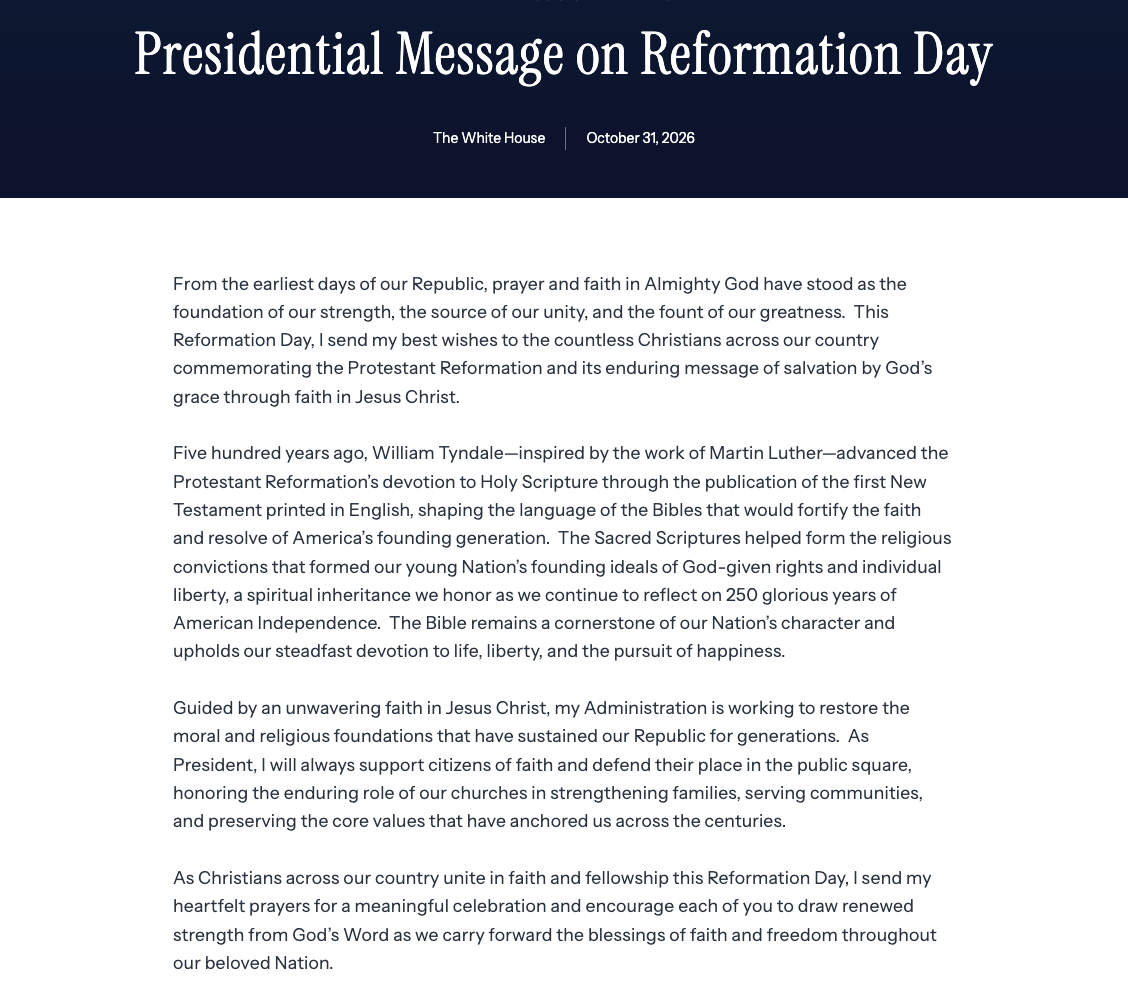
Presidential Message on Reformation Day (The White House, October 31, 2026)
From the earliest days of our Republic, prayer and faith in Almighty God have stood as the foundation of our strength, the source of our unity, and the fount of our greatness. This Reformation Day, I send my best wishes to the countless Christians across our country commemorating the Protestant Reformation and its enduring message of salvation by God’s grace through faith in Jesus Christ.
Five hundred years ago, William Tyndale—inspired by the work of Martin Luther—advanced the Protestant Reformation’s devotion to Holy Scripture through the publication of the first New Testament printed in English, shaping the language of the Bibles that would fortify the faith and resolve of America’s founding generation. The Sacred Scriptures helped form the religious convictions that formed our young Nation’s founding ideals of God-given rights and individual liberty, a spiritual inheritance we honor as we continue to reflect on 250 glorious years of American Independence. The Bible remains a cornerstone of our Nation’s character and upholds our steadfast devotion to life, liberty, and the pursuit of happiness.
Guided by an unwavering faith in Jesus Christ, my Administration is working to restore the moral and religious foundations that have sustained our Republic for generations. As President, I will always support citizens of faith and defend their place in the public square, honoring the enduring role of our churches in strengthening families, serving communities, and preserving the core values that have anchored us across the centuries.
As Christians across our country unite in faith and fellowship this Reformation Day, I send my heartfelt prayers for a meaningful celebration and encourage each of you to draw renewed strength from God’s Word as we carry forward the blessings of faith and freedom throughout our beloved Nation.
Scripture quotations are from the Berean Standard Bible. Confessional references follow the Kolb-Wengert edition of the Book of Concord.
Published under the Ordinary Means imprint. Free for congregational use.
Continue reading
- For Weary Evangelicals
The Left Hand
Vocation, Neighbor, and the Christian Life
You did not miss God’s will for your life. Vocation is received, not discovered: God is already at work through your ordinary callings, and none of them measures whether you are His.